This is the multi-page printable view of this section. Click here to print.

Return to the regular view of this page.

About DAIC

Overview of the Delft AI Cluster (DAIC) and its role in high-performance computing at TU Delft.

What is an HPC cluster?

A high-performance computing (HPC) cluster is a collection of interconnected compute resources (like CPUs, GPUs, memory, and storage) shared among a group of users. These resources work together to perform lengthy and computationally intensive tasks that would be too large or too slow on a single computer. HPC is especially useful for modern scientific computing applications, where datasets are typically large, models are complex, and computations require specialized hardware (such as GPUs or FPGAs).

What is DAIC?

The Delft AI Cluster (DAIC), formerly known as INSY-HPC (or simply “HPC”), is a TU Delft high-performance computing cluster consisting of Linux compute nodes (i.e., servers) with substantial processing power and memory for running large, long, or GPU-enabled jobs.

What started in 2015 as a CS-only cluster has grown to serve researchers across many TU Delft departments. Each expansion has continued to support the needs of computer science and AI research. Today, DAIC nodes are organized into partitions that correspond to the groups contributing those resources. (See Contributing departments and TU Delft clusters comparison.)
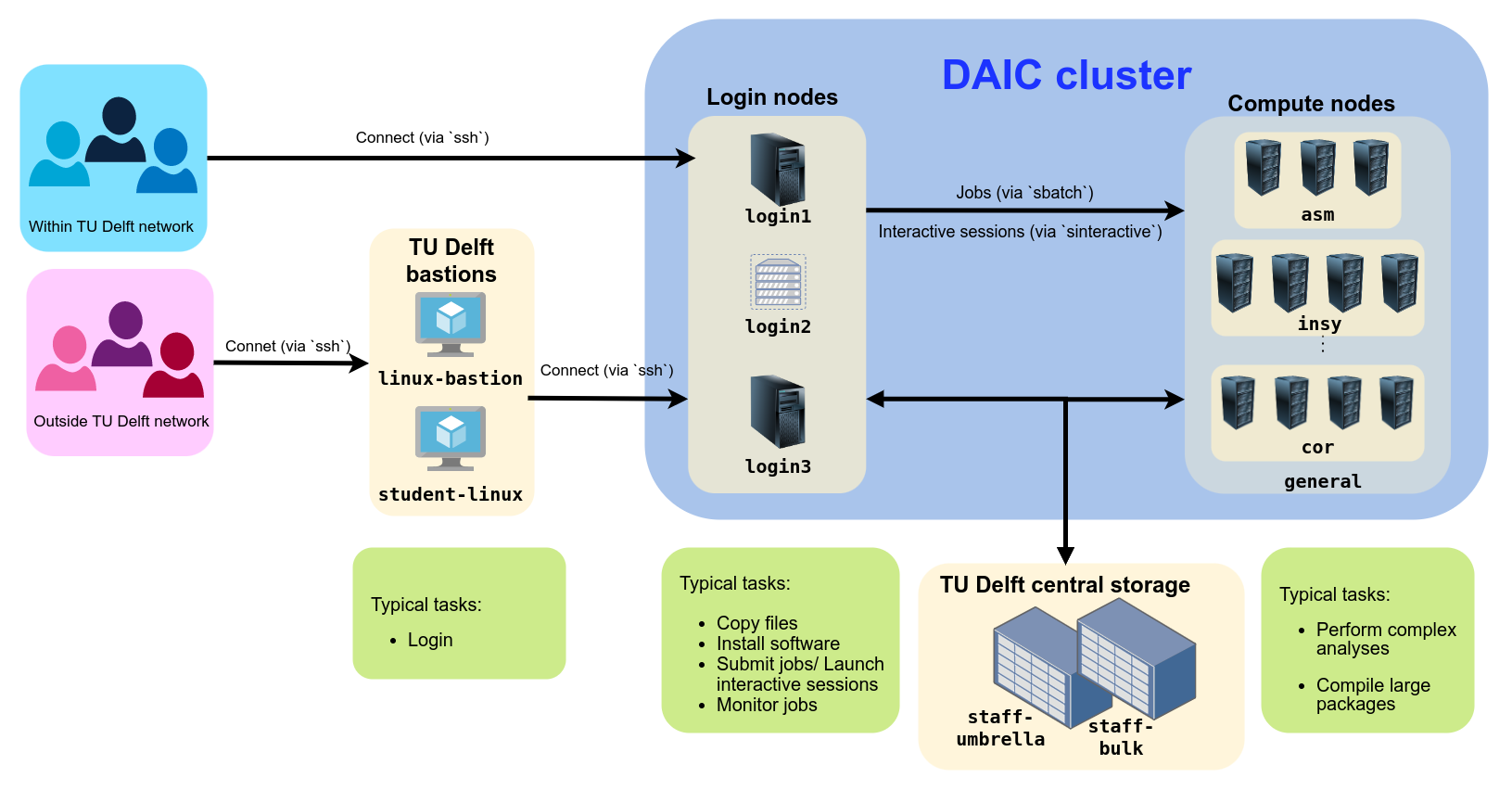
DAIC partitions and access/usage best practices

DAIC partitions and access/usage best practices

1 - Contributors

Advisory board, contributing departments, and funding sources.

Advisory board

Thomas Abeel
Thomas Abeel
Intelligent Systems
Frans Oliehoek
Frans Oliehoek
Intelligent Systems
Asterios Katsifodimos
Software Technology

History

The Delft AI Cluster (DAIC)—formerly known as INSY-HPC or simply HPC—was initiated within the INSY department in 2015. In later phases, resources were merged with the ST department (collectively called CS@Delft) and expanded further with contributions from other departments across multiple faculties.

Contributing departments

The cluster is available only to users from participating departments. Access is arranged through your department’s contact persons (see Access and accounts).

Table 1: Current DAIC-contributing TU Delft departments/faculties
IContributorFacultyFaculty abbreviation (English/Dutch)
13D GeoinformationFaculty of Architecture and the Built EnvironmentABE/BK
2Architecture
3Aerospace Structures and MaterialsFaculty of Aerospace EngineeringAE/LR
4Control and Operations
5Imaging PhysicsFaculty of Applied SciencesAS/TNW
6Cognitive RoboticsFaculty of Mechanical EngineeringME
7Geoscience & Remote SensingFaculty of Civil Engineering and GeosciencesCEG/CiTG
8Intelligent SystemsFaculty of Electrical Engineering, Mathematics & Computer ScienceEEMCS/EWI
9Software Technology
10Signal Processing Systems, Microelectronics

Funding sources

In addition to funding from contributing departments, DAIC has received support from the following projects and funding sources:

NWO

Horizon 2020

Epistemic AI

MMLL

Booking.com

D-STANDARD

Model-Driven Decisions Lab (MoDDL)
Immersive Tech Lab

Immersive Technology Lab, part of Convergence AI

Jet Brains

2 - Impact

Scientific impact of DAIC.

Scientific impact in numbers

Since 2015, DAIC has facilitated more than 2,000 scientific outputs from participating departments:

ArticleConference/Meeting contributionBook/Book chapter/Book editingDissertation (TU Delft)AbstractOtherEditorialPatentGrand Total
Grand Total10678541239969322982281

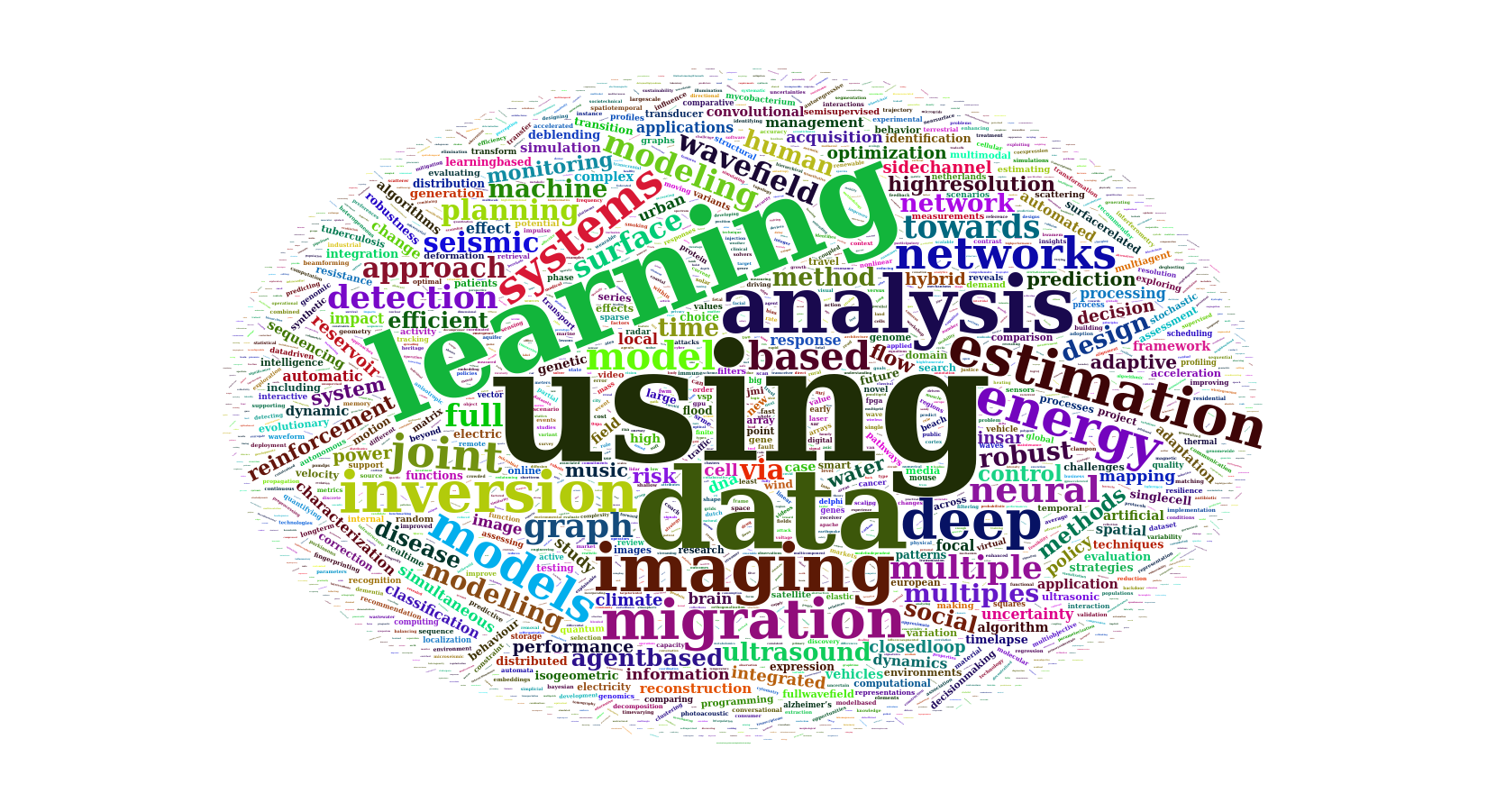
These outputs span a wide range of research areas. Title analysis highlights frequent use of terms related to data analysis and machine learning:

Word cloud of the most common words in scientific output titles using DAIC

Word cloud of the most common words in scientific output titles using DAIC

Publications using DAIC

3 - How to Cite

How to cite and acknowledge DAIC in publications.

To help demonstrate the impact of DAIC, we ask that you both cite and acknowledge DAIC in your scientific publications.

Citation

Delft AI Cluster (DAIC). (2024). The Delft AI Cluster (DAIC), RRID:SCR_025091. https://doi.org/10.4233/rrid:scr_025091

@misc{DAIC,
  author = {{Delft AI Cluster (DAIC)}},
  title = {The Delft AI Cluster (DAIC), RRID:SCR_025091},
  year = {2024},
  doi = {10.4233/rrid:scr_025091},
  url = {https://daic.tudelft.nl/}
}
TY  - DATA
T1  - The Delft AI Cluster (DAIC), RRID:SCR_025091
UR  - https://doi.org/10.4233/rrid:scr_025091
PB  - TU Delft
PY  - 2024

Acknowledgement

Acknowledgement text

Research reported in this work was partially or completely facilitated by computational resources and support of the Delft AI Cluster (DAIC) at TU Delft (RRID: SCR_025091), but remains the sole responsibility of the authors, not the DAIC team.